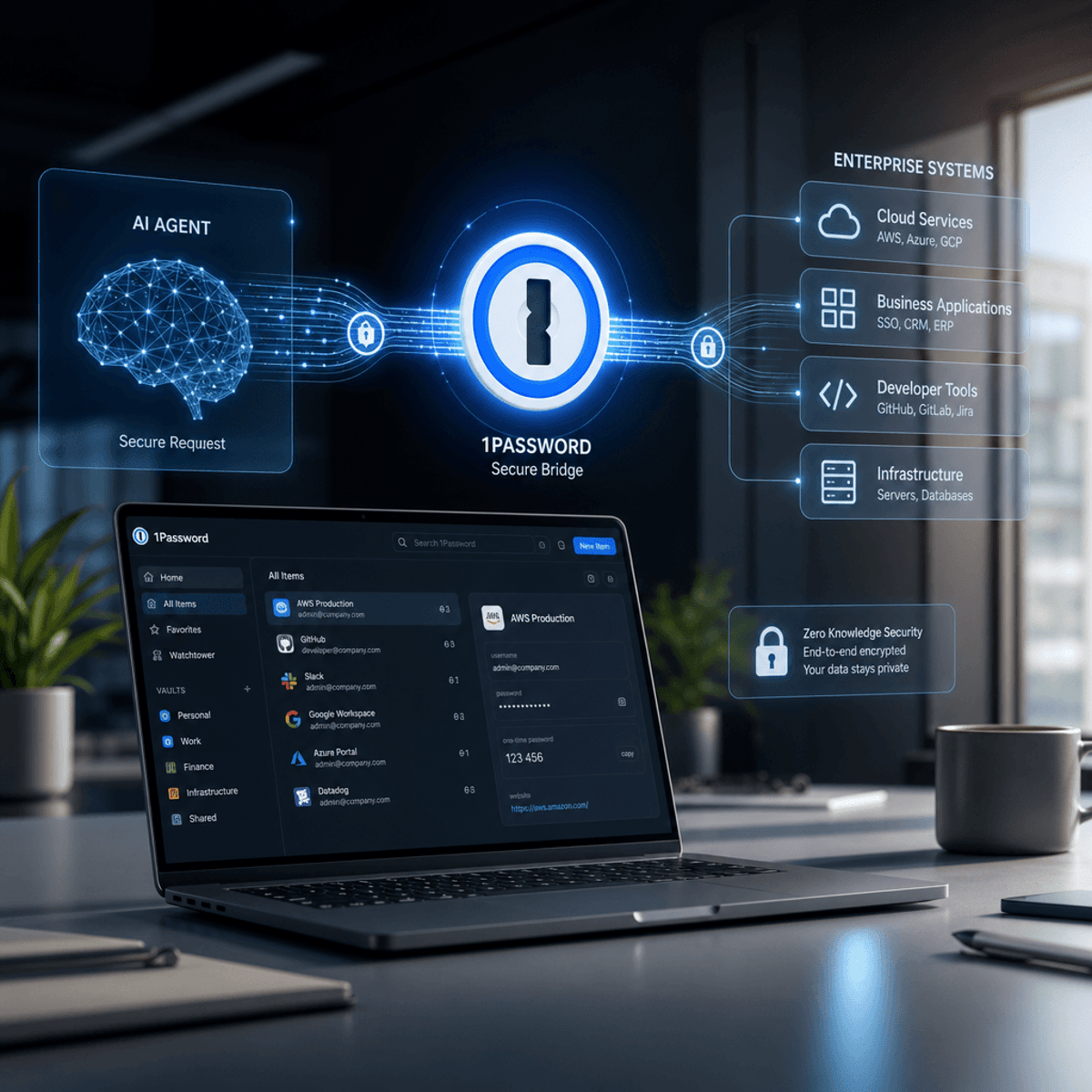
In a bold move that could reshape how we think about password management, 1Password announced today that its platform will now support AI agents capable of logging in on your behalf without ever exposing your password. The feature, announced during a live virtual event, is built on the company’s existing secure enclave and new AI‑driven authentication layer.
What 1Password Just Launched
Under the hood, 1Password’s AI agents are essentially trusted bots that sit within the user’s encrypted vault. When a user requests a login, the agent retrieves the necessary credentials, encrypts them, and then uses a token‑based handshake to authenticate with the target service. The key distinction is that the password never leaves the encrypted vault; the agent simply passes a one‑time token that the service accepts in place of the plaintext secret.
Token‑Based Authentication Explained
Traditional password entry involves typing or pasting the secret into a login form, which can expose it to keyloggers, shoulder surfers, or even browser autofill vulnerabilities. With token‑based authentication, the agent generates a short‑lived cryptographic token that the service validates against its own security policy. Once the token is consumed, it cannot be reused, eliminating the risk of replay attacks.
How the AI Agent Works
The process unfolds in three steps:
- Credential Retrieval: The agent pulls the encrypted password from the vault and decrypts it locally on the device.
- Token Generation: Using a secure random number generator, the agent creates a one‑time token signed with the user’s private key.
- Service Authentication: The token is sent to the target service’s API. The service verifies the signature and, if valid, grants access without ever seeing the raw password.
Because the agent operates entirely within the encrypted environment, even a compromised device cannot expose the password. The only data exposed to the service is the token, which has no value outside of that specific authentication session.
Implications for Users and Developers
For everyday users, the experience feels like an invisible helper: you simply click “Log in with 1Password,” and the agent handles the rest. This removes the friction of remembering or typing long, complex passwords, while keeping the underlying secret safe.
Developers of web and mobile apps will need to adapt their authentication flows to accept token‑based logins. 1Password has released an SDK that abstracts the token generation, allowing developers to integrate the feature with minimal code changes. The company also announced a compliance roadmap to ensure compatibility with major identity providers such as Google, Microsoft, and Apple.
From a security standpoint, the new model aligns with emerging industry trends toward passwordless authentication. By reducing the attack surface associated with static passwords, 1Password’s AI agents provide an extra layer of defense against credential stuffing, phishing, and keylogging attacks.
A Takeaway for the Future
What this launch signals is that the boundary between human and machine in authentication is blurring. AI agents can act as secure intermediaries, preserving the confidentiality of secrets while offering the convenience of seamless logins. For the broader tech ecosystem, the next step will be standardizing token protocols so that this approach can be widely adopted across platforms without compromising user privacy.